This was an abbreviation I had seen so much of during my research into studying medicine at university. Now, this was going to be my main assessment for second year!
An OSCE is essentially similar to the MMI stations that you will (have) sit to get into uni. The stations are made up of a number of sections and each OSCE will have a certain number of stations in total. For my exam, there were three stations with each being divided into three sections.
Each station would test an aspect of the content that had been taught in both years 1 and 2. It would involve a history or an examination on a patient with a presenting complaint, so like chest pain or breathlessness. It would then be followed with an interpretation task. So this could be looking at an x-ray (to test anatomy), processing lab data (to test practicals and lecture content) or interpreting graphical data. Finally, would have to explain something to the patient (ie. what they have, how to use an inhaler etc) or activate them to change their lifestyle (ie. stop smoking, stop drinking alcohol etc). The station could also have a clinical skill which we would’ve learnt In our clinical encounters, like dipsticking urine or doing a manual blood pressure.
But there were three of these stations to break it up (eg. One on chest pain, one on breathlessness and one on abdominal pain).
The examiner would sit there with a clipboard and tick as you were talking and working with the patient. The patient was an actor pretending to have the condition, or real patients who had what they were actually describing (eg. Psoriasis).
The whole exam lasted an hour. (Each station was 20 minutes)
It was great how the exams were so practical and you actually felt like a medical professional whilst speaking to the actor patients. It was very pressurising, like any exam, as the trick was to look both confident and friendly. In these examinations, you're being tested on both your person skills as well as your knowledge!
I got my results about a month later and was over the moon with a pass! Roll on Year 3...
Showing posts with label exams. Show all posts
Showing posts with label exams. Show all posts
Wednesday, 29 May 2019

Wednesday, 15 August 2018
A-Level Exams Results Day
Hello everyone!
Hope you are enjoying the summer as much as I have been! But, it's come to the dreaded month of August which contains the fortnight of results weeks. It is the most dreaded day of the year... even exceeding that stress you experienced when you sat the exams.
So in the summer period, you have sat your A-Level exams, hopefully one of them being Chemistry and usually the two others being another science and/or maths etc. I really hope that they went well for you and now your results will shine through.
As I think I mentioned in one of my earlier posts, throughout the year I did shockingly bad in my mocks. I could never achieve my target grade and my motivation was constantly being knocked. My school did for some bizarre reason use a method of collating extremely hard exam questions into a bank that we were tested on pretty much monthly - this of course screams "You're not gonna pass." whenever you got the results of another B, C and sometimes even U.
But you can imagine my astonishment on results day, a year ago, when I opened my envelope to see that I had achieved my entry requirement to get into the University of Bristol.
The main message I am trying to convey here is that sometimes exams don't go exactly how you plan them. You need to remember that you will only remember the BAD from the exam. Why didn't I put that? I can't believe I ran out of time to answer that question... Why on earth did I put that AS THE ANSWER? But you never think of the possible 50-60% of the answers that you did really well on! And sometimes, your 5/6 mark answers will still bag you half marks! These marks all add up and hopefully will give you the result you are looking for.
What if it all goes wrong? Well, getting into medicine has no deadline at all (apart from the application deadline in October!). So, if you open up those results and you didn't achieve the AAA, oh well! Either call through to Clearing and see if you are able to go into another university to study Medicine (where I believe they give a short interview on the phone. so I've heard?) and you may still be able to bag a place. However, if that isn't available, then I would certainly recommend to consider retaking.
By retaking, you can have another attempt at achieving the grades required.
Hope you are enjoying the summer as much as I have been! But, it's come to the dreaded month of August which contains the fortnight of results weeks. It is the most dreaded day of the year... even exceeding that stress you experienced when you sat the exams.
So in the summer period, you have sat your A-Level exams, hopefully one of them being Chemistry and usually the two others being another science and/or maths etc. I really hope that they went well for you and now your results will shine through.
As I think I mentioned in one of my earlier posts, throughout the year I did shockingly bad in my mocks. I could never achieve my target grade and my motivation was constantly being knocked. My school did for some bizarre reason use a method of collating extremely hard exam questions into a bank that we were tested on pretty much monthly - this of course screams "You're not gonna pass." whenever you got the results of another B, C and sometimes even U.
But you can imagine my astonishment on results day, a year ago, when I opened my envelope to see that I had achieved my entry requirement to get into the University of Bristol.
The main message I am trying to convey here is that sometimes exams don't go exactly how you plan them. You need to remember that you will only remember the BAD from the exam. Why didn't I put that? I can't believe I ran out of time to answer that question... Why on earth did I put that AS THE ANSWER? But you never think of the possible 50-60% of the answers that you did really well on! And sometimes, your 5/6 mark answers will still bag you half marks! These marks all add up and hopefully will give you the result you are looking for.
What if it all goes wrong? Well, getting into medicine has no deadline at all (apart from the application deadline in October!). So, if you open up those results and you didn't achieve the AAA, oh well! Either call through to Clearing and see if you are able to go into another university to study Medicine (where I believe they give a short interview on the phone. so I've heard?) and you may still be able to bag a place. However, if that isn't available, then I would certainly recommend to consider retaking.
By retaking, you can have another attempt at achieving the grades required.
- Some universities are rumoured to 'not accept retakes' by students that failed the year before and then apply again the following year. This is not particularly true. What I can gather from open days, if you didn't achieve the exams because of extenuating circumstances, there is a chance you could be shortlisted for an interview the following year.
- Some universities will not accept a candidate reapplying the following year after failing exams without extenuating circumstances.
- Through my own research and recommended by open days, universities will not accept a candidate who is applying after applying previously, being accepted and getting the grades but then doing a late deferral for no extenuating circumstance = eg. "I want to take a gap year, despite not putting on my application that I wanted to when I applied."
- If you are going to retake, do you want to stay in the same school? Do you think college would be better suited for you this year? Or possibly transferring to sixth form if you are already at college? You need to take chemistry, but what about the other two options? Maybe drop Maths and pick up Physics? Or drop Physics to pick up Biology?
- Finally, remember it is not all in the schooling to why you may have failed. Consider in your retaking year what may have led you to slip. Did you go out too much? Did you prioritise your time incorrectly? Did you not concentrate, slip behind work, stop attending? Maybe you hadn't mastered your revision technique correctly? This year, make sure you build on this 'mistakes' to ensure you achieve those results for next year!
I hope this post has provided some ease and I promise this time tomorrow you will be much more relaxed no matter the outcome. I hope you will be sat with your family having a nice meal celebrating your success in securing a place in medical school.
Massive good luck to you all!
Saturday, 23 June 2018
Summary of Year 1
Let's do an overall summary of Year 1...
- I arrived at university and met my flatmates. I had to make all new friends from my course and my student accommodation, who thankfully remained by my side throughout the whole year!
- I did house viewings and decided on my accommodation flat for next year!
- I learnt soooo much! From anatomy, to law, to sociology, to ethics, to histology, to biomedicine to biochemistry! There has been so much content on each individual system in the body which you can't help but feel excited to turn up to lectures.
- I have handled a lot of cadaver specimens and have been exposed prematurely to death. I have also taken part in shadowing a pathologist during a post mortem.
- I have taken part in clinical shadowing at GPs, where I did some clinical skills and did individual home visits. Here, I learnt how important communication is when it comes to talking to patients.
- I have also shadowed doctors at Southmead Hospital and have been taught by both patients and the teaching fellows about body systems and some clinical skills - such as taking blood pressure, blood glucose levels, auscultation and palpation.
- I completed an essay project, as well as an art project. This is based on medicine being both a science and an art.
- I have worked as HCA as part of the course, where I worked four shifts of 7 hours and one 12 hour shift.
- I loved being a HCA so much, I then went on to apply for a job as a healthcare assistant in Bristol. I went for the interview and then received my job offer. I then attended the training and now awaiting some shifts to sign up to!
- I have completed my exams, January and Summer and passed to progress into Year 2!
 |
| I can't believe how much I feel I know ever since starting just less than a year ago! |
Year 1 has been filled with some very exciting moments and I have enjoyed every second of university life. You are so independent and have so much fun which is incomparable to any other experience I have ever had! I would say I would love to do it again, but I'm really excited to go into Year 2!
I hope all of your exams go well and you receive the results you both want and deserve. Have a great summer, and I will speak to you in September if not before!
Wednesday, 20 June 2018
...and the results are in...
Guess who is 20% a qualified doctor??? ME!!!
Yup, somehow, I passed my exams! I feel like it was a huge reward for all of the hardwork that I put in towards the end of the year (from the beginning of May up to the exams) even with the circumstances going on.
I will use this chance to say about the grading with medicine as well! I'm not sure if I mentioned it in the last posts so I'll say here, medicine does not have the standard first, 2:1, 2:2, third etc. scale which is used to measure and assess other courses.
So you will hear that a lot, "Did you get a first or a second in your exam?" around the university. But medicine is simply a pass or fail. This then determines your next progression into the following year. So because of this, I have completed Year 1 and will progress to Year 2 next year!
Thank you to everyone that supported me, especially the past month. I am truly grateful for everything.
Yup, somehow, I passed my exams! I feel like it was a huge reward for all of the hardwork that I put in towards the end of the year (from the beginning of May up to the exams) even with the circumstances going on.
I will use this chance to say about the grading with medicine as well! I'm not sure if I mentioned it in the last posts so I'll say here, medicine does not have the standard first, 2:1, 2:2, third etc. scale which is used to measure and assess other courses.
So you will hear that a lot, "Did you get a first or a second in your exam?" around the university. But medicine is simply a pass or fail. This then determines your next progression into the following year. So because of this, I have completed Year 1 and will progress to Year 2 next year!
 |
| I'm progressing into Year 2! |
Friday, 8 June 2018
Summer Exams
Preparing for the exams has awful and sadly not because of the stress of exams. Whilst at university, I was informed by my friends at home that a close dear friend of mine had passed away at his university. This came as a great shock to me and I wasn't prepared to process such news as devastating as this. I was fortunate enough to attend his funeral and speak my eulogy that aimed to portray his fun and exciting character that I miss dearly. His funeral was the 6th June, whereas my first exam was the 5th June and my second exam was the 7th June. So sandwiched between the two examinations, I had to travel home promptly within the time to ensure I would make his funeral.
...
But the main question - what were the exams like?
Short answer: Difficult! Haha.
It's nothing like A-Level testing. The exam MCQs give you five possible answers to a question that could be a one line to a whole paragraph describing a patient's history. You guarantee that you will find yourself deciding between two answers and then it's pot luck if you aren't confident to the answer!
The exams were also weighted massively on the delivery of teaching. The majority of the exam was on physiology and function, closely followed by anatomy and then broken up into questions on the sociological, behavioural and ethical aspects of the course.
Here is an example of a medical MCQ! (And how I would approach such question in an exam situation)
Which cranial nerve is responsible for the abduction of the eye?
a) CN II
b) CN III
c) CN IV
d) CN V
e) CN VI
So... the breakdown on this question. You could either work out each individual cranial nerve and what it supplies, but I found it was always quicker to just dissect what the exam question is both asking for and looking for.
I'd begin with a quick sketch of the eye...
On the sketch, I would quickly drawn on the eye movements and the name of the muscles that are responsible for this. I would have learnt this mainly from my anatomy sessions when I located these muscles on cadavers and learnt their functions. Then, in the neuro case, I would've elaborated on each individual cranial nerve and what motor supplies they have.
I would then draw the names of the eye movements:
This is important because I need to be able to understand what movement I am trying to identify. In this case, abduction is the lateral movement (meaning the eyeball moves away in a direction away from the nose). Comparing the diagrams, it is clear that lateral rectus is the muscle responsible for abduction of the eyeball.
Then, I would just have to either remember from my revision that the lateral rectus muscle is innervated by CN VI. Or, I could've looked at the answers in turn. Cranial nerve six, CN VI, is actually called the abducens nerve. So this would've saved me time if I had remembered the common name of this cranial nerve! Or I could've worked down the functions and remember that CN II is the optic nerve which provides sensory information of sight etc. Or, remembered that CN VI is the only cranial nerve to supply the lateral rectus muscle ... which causes eye abduction!
It may not make sense now, but you'll be laughing how easy this is to understand when you complete your first months of medical school - trust me!
If you are looking for my opinion of the exams, I would say they were very difficult. They were quite confusing and used a lot of application! I know in the example, I gave an MCQ which would be structured similar to how the teaching would be delivered. But there were a lot of questions on symptoms and a list of possible conditions which we had touched on throughout the year.
I found the second paper a lot harder than the first. Obviously, the circumstance of my friend's funeral being present during my revision time didn't help either, but I will confirm that I did apply for extenuating circumstances. Results day will tell me more!
Good luck to everyone else who has exams at this time!
...
But the main question - what were the exams like?
Short answer: Difficult! Haha.
It's nothing like A-Level testing. The exam MCQs give you five possible answers to a question that could be a one line to a whole paragraph describing a patient's history. You guarantee that you will find yourself deciding between two answers and then it's pot luck if you aren't confident to the answer!
The exams were also weighted massively on the delivery of teaching. The majority of the exam was on physiology and function, closely followed by anatomy and then broken up into questions on the sociological, behavioural and ethical aspects of the course.
Here is an example of a medical MCQ! (And how I would approach such question in an exam situation)
Which cranial nerve is responsible for the abduction of the eye?
a) CN II
b) CN III
c) CN IV
d) CN V
e) CN VI
So... the breakdown on this question. You could either work out each individual cranial nerve and what it supplies, but I found it was always quicker to just dissect what the exam question is both asking for and looking for.
I'd begin with a quick sketch of the eye...
 |
| A small sketched diagram I would draw next to the question that I've annotated. The line on the left represents the nose, showing that this eye would be the left eye. |
On the sketch, I would quickly drawn on the eye movements and the name of the muscles that are responsible for this. I would have learnt this mainly from my anatomy sessions when I located these muscles on cadavers and learnt their functions. Then, in the neuro case, I would've elaborated on each individual cranial nerve and what motor supplies they have.
I would then draw the names of the eye movements:
 |
| Another small diagram showing the names of movements of the left eye. |
This is important because I need to be able to understand what movement I am trying to identify. In this case, abduction is the lateral movement (meaning the eyeball moves away in a direction away from the nose). Comparing the diagrams, it is clear that lateral rectus is the muscle responsible for abduction of the eyeball.
Then, I would just have to either remember from my revision that the lateral rectus muscle is innervated by CN VI. Or, I could've looked at the answers in turn. Cranial nerve six, CN VI, is actually called the abducens nerve. So this would've saved me time if I had remembered the common name of this cranial nerve! Or I could've worked down the functions and remember that CN II is the optic nerve which provides sensory information of sight etc. Or, remembered that CN VI is the only cranial nerve to supply the lateral rectus muscle ... which causes eye abduction!
It may not make sense now, but you'll be laughing how easy this is to understand when you complete your first months of medical school - trust me!
If you are looking for my opinion of the exams, I would say they were very difficult. They were quite confusing and used a lot of application! I know in the example, I gave an MCQ which would be structured similar to how the teaching would be delivered. But there were a lot of questions on symptoms and a list of possible conditions which we had touched on throughout the year.
I found the second paper a lot harder than the first. Obviously, the circumstance of my friend's funeral being present during my revision time didn't help either, but I will confirm that I did apply for extenuating circumstances. Results day will tell me more!
Good luck to everyone else who has exams at this time!
Tuesday, 1 May 2018
Preparation for Exams
At the moment, I still attend university in the week because we are still learning content. We are still learning about the Neuro system (which involves the brain, central nervous system and peripheral nervous system) and the Endocrine system (which involves the glands and hormones around the body). As mentioned before, this content is being delivered through lectures, facilitation sessions (because we are doing CBL), laboratory sessions and the clinical placements at the hospital and the GP.
Between these hours at university, I have been finding the time to balance revising for my exams. I have two exams this year which are both written multiple choice exams. Whereas in my January exams, if you can remember, I had to complete a written examination of MCQs (multiple choice questions) but also a 'spot' function exam (which involves cadaver specimens with pins labelling structures we should identify / explain their function fully) - but in my summer exams, I just have two written papers! Both of these exams are MCQs, 80 of them, which will test all aspects of the course from the beginning (Yes! ... from September 2017!)
So, I had to revise all of the ethics, all of the behaviour and social sciences (including sociology), some of the law content and the biomedical parts. Alongside this, I had to revise anatomy, histology and the function of each of the structures I could identify from a variety of photographs.
The worst part about revising for these exams is that I love working from past papers! They were my 'go to' resource which helped consolidate my knowledge. But unfortunately, I have no bank of past paper questions to go by! Some of our lectures though did give a small example of what a multiple choice question concerned with the lecture would look like, so I did stick all of those into a document that I printed and made an attempt at.
I did find quite a few online MCQ flashcard applications which had pre-made Year 1 medical questions which were composed by other medical students. Obviously, there were a lot of questions I didn't know because they weren't part of my curriculum. Therefore, I broke up the content and searched for questions on those individually. For example, looking up quiz MCQs on 'Anatomy of the Thorax' or 'Histology Images of Epithelial Cells'.
My exams are in the beginning of June which is very late in comparison with my friends. My friends finish their exams mostly in the middle of May, where they will be heading home for summer. So, I will be revising in the flat alone! Some of my friends from other universities studying other courses had a few exams at the end of April and were done for the summer! I'm very jealous.
To revise, I found the best way to learn anatomy was to study myself! I drew on my body quite a lot, highlighting different areas which were important to remember. For example, remembering the palmar arches in the hand, and whether it is the radial or ulnar artery which supplies them mostly individually.
With all of the other notes I had typed up based on attending my labs and lectures, I practised writing them out by hand in a notebook. It was quite good practice to consolidate my learning in this way, as I was reading my notes and then testing whether I could reproduce the information on a blank page. If I made an error, I could learn from such mistake.
This was also during the period of the heatwave that hit England! You can imagine how horrible it was to sit in the library as the scorching sun shone through the window and burnt your arm. It was more of a killer getting invited to join mates in pub gardens when you know you should be studying hard!
I did give in though, I cooked a barbecue for my flatmates and we sat on the field drinking ciders and soaking up the sunshine while it was here!
 |
| How the majority of my days were spent throughout May! |
So, I had to revise all of the ethics, all of the behaviour and social sciences (including sociology), some of the law content and the biomedical parts. Alongside this, I had to revise anatomy, histology and the function of each of the structures I could identify from a variety of photographs.
The worst part about revising for these exams is that I love working from past papers! They were my 'go to' resource which helped consolidate my knowledge. But unfortunately, I have no bank of past paper questions to go by! Some of our lectures though did give a small example of what a multiple choice question concerned with the lecture would look like, so I did stick all of those into a document that I printed and made an attempt at.
I did find quite a few online MCQ flashcard applications which had pre-made Year 1 medical questions which were composed by other medical students. Obviously, there were a lot of questions I didn't know because they weren't part of my curriculum. Therefore, I broke up the content and searched for questions on those individually. For example, looking up quiz MCQs on 'Anatomy of the Thorax' or 'Histology Images of Epithelial Cells'.
My exams are in the beginning of June which is very late in comparison with my friends. My friends finish their exams mostly in the middle of May, where they will be heading home for summer. So, I will be revising in the flat alone! Some of my friends from other universities studying other courses had a few exams at the end of April and were done for the summer! I'm very jealous.
To revise, I found the best way to learn anatomy was to study myself! I drew on my body quite a lot, highlighting different areas which were important to remember. For example, remembering the palmar arches in the hand, and whether it is the radial or ulnar artery which supplies them mostly individually.
With all of the other notes I had typed up based on attending my labs and lectures, I practised writing them out by hand in a notebook. It was quite good practice to consolidate my learning in this way, as I was reading my notes and then testing whether I could reproduce the information on a blank page. If I made an error, I could learn from such mistake.
 |
| I drew on my arm to try and get an idea where the structures were located on myself. |
 |
| Caffeine overload! To stay awake, I found myself turning to Red Bull and coffee for the boost I needed! |
 |
| Barbecuing on the downs! |
Tuesday, 27 March 2018
Art Project...in progress
If you are interested in how the art assignment is working out at the moment, I have so far finished making the centre piece which is the anatomical representation of the abdomen. Being clay, it needs to dry out before it is fired and can be painted.
I'm thinking at the moment of painting the whole abdomen in its true colours (ie. slightly pinkish stomach, purple-like spleen, dark red liver etc) or painting them in paler pastel colours and the three kidneys in darker colours to bring attention onto them.
I plan to make small pills and capsules out of clay to represent the medication, and to stick this in some areas of the abdomen to show the reliance and dependence to keep the system working.
As mentioned, the main purpose of my piece is to represent the dependence on medication (I was overwhelmed by the number of drugs transplant patients are administered after their operation!). So as the background of the board which my clay will be mounted to, I have designed these drugs based on the actual medication.
Example, I have found the name of certain immunosuppressants which are prescribed to renal transplant patients and have designed these on my computer (some based on their actual packets I could find online) and then printed these out and stuck them as a montage on the wooden board. I have also measured up and printed some of my own medication packets to stick to the boxes of over-the-counter medicines I had bought for this project. By doing so, I also have spare medicine packets that I can stick to my work too.
I'm thinking at the moment of painting the whole abdomen in its true colours (ie. slightly pinkish stomach, purple-like spleen, dark red liver etc) or painting them in paler pastel colours and the three kidneys in darker colours to bring attention onto them.
I plan to make small pills and capsules out of clay to represent the medication, and to stick this in some areas of the abdomen to show the reliance and dependence to keep the system working.
 |
| The holes in the hilum of the kidney and the major vessels in the centre (inferior vena cava and the abdominal aorta) will have coloured piping stuck into it which will connect them up. The clay was too fragile to roll thinly and connect as blood vessels (and the ureters), therefore I will do this after it has been fired. |
 |
| The two kidneys have polycystic kidney disease, which meant I could use smaller pieces of clay rolled into balls to produce these cysts that are growing all over the kidney. I even scooped some clay out to represent burst cysts. The transplanted kidney is located at the bottom left. |
As mentioned, the main purpose of my piece is to represent the dependence on medication (I was overwhelmed by the number of drugs transplant patients are administered after their operation!). So as the background of the board which my clay will be mounted to, I have designed these drugs based on the actual medication.
Example, I have found the name of certain immunosuppressants which are prescribed to renal transplant patients and have designed these on my computer (some based on their actual packets I could find online) and then printed these out and stuck them as a montage on the wooden board. I have also measured up and printed some of my own medication packets to stick to the boxes of over-the-counter medicines I had bought for this project. By doing so, I also have spare medicine packets that I can stick to my work too.
 |
| The montage of different medications that a renal transplant patient may be taking. I designed the packets online and stuck them to the board as a montage background for my clay piece. |
Sunday, 25 March 2018
Assignments.... science vs. arts!
At the beginning of the year, I remember laughing with my flatmates how great it is that we don't get as many essays compared to other subjects. One of my flatmates who does biology is always complaining about another essay or report she has to do.
But, we were set an awful essay on discussing *something* and its impact on human health and wellbeing. The *something* had to be appropriate and from a certain list we were given (ie. diet, exercise, loneliness etc). I decided to do how owning a dog affects human health and wellbeing, which I thought initially would be very interesting. Was it? Of course not. For every paper that said owning a dog lowers your blood pressure, there was a study that proved that wasn't the case.
It was very complicated and repetitive, but I ploughed through. I lost out on a really good night, but I guess it was my fault for leaving it until the week it was due. Literature reviews and breaking down medical scientific journals is a talent that I really don't think I have compared to my friends.
My uni though is trying to promote this concept of medicine being both an art and a science. Therefore, we have also been set an art assignment. We have to base this on a clinical encounter that we have had or observed.
I have decided to create a reflective piece based on a patient that I met whilst doing a home visit in my GP placement. She has polycystic kidney disease, and her poor kidney function led to her having a kidney transplant. I was very shocked to learn that unless cancerous or posting a serious threat to life, they keep the kidneys inside you! I always thought they removed it during a transplant, but no!
The patient told me about how she believes it's the medication that is keeping her going. So I have based my art project solely on the amazing concept of a renal transplant, but also the dependence on medication to stay alive.
The plan for my art piece: an anatomical representation of the abdomen with the transplanted kidney (from the posterior abdominal muscles, to the bladder, major blood vessels, two PKD-affected kidneys, a transplanted kidney, to the liver, the stomach and the spleen). This will be moulded out of clay, dried over the holiday and fired in a kiln in the final week and ready for the deadline of the 20th April. Surrounding my clay piece will be the tablets a renal patient will be taking to prevent rejection or any infection post-operation. I have researched these drugs online, and through the use of NHS renal transplant information leaflets which are given to patients before or after their transplant operation.
I will keep you updated on how this turns out!
But, we were set an awful essay on discussing *something* and its impact on human health and wellbeing. The *something* had to be appropriate and from a certain list we were given (ie. diet, exercise, loneliness etc). I decided to do how owning a dog affects human health and wellbeing, which I thought initially would be very interesting. Was it? Of course not. For every paper that said owning a dog lowers your blood pressure, there was a study that proved that wasn't the case.
 |
| My essay based on the impact of owning a dog on human health and wellbeing. One of the hardest parts of writing this essay was actually trying to reference using the Vancouver method as opposed to Harvard, which is what I'm used to! |
It was very complicated and repetitive, but I ploughed through. I lost out on a really good night, but I guess it was my fault for leaving it until the week it was due. Literature reviews and breaking down medical scientific journals is a talent that I really don't think I have compared to my friends.
My uni though is trying to promote this concept of medicine being both an art and a science. Therefore, we have also been set an art assignment. We have to base this on a clinical encounter that we have had or observed.
I have decided to create a reflective piece based on a patient that I met whilst doing a home visit in my GP placement. She has polycystic kidney disease, and her poor kidney function led to her having a kidney transplant. I was very shocked to learn that unless cancerous or posting a serious threat to life, they keep the kidneys inside you! I always thought they removed it during a transplant, but no!
The patient told me about how she believes it's the medication that is keeping her going. So I have based my art project solely on the amazing concept of a renal transplant, but also the dependence on medication to stay alive.
The plan for my art piece: an anatomical representation of the abdomen with the transplanted kidney (from the posterior abdominal muscles, to the bladder, major blood vessels, two PKD-affected kidneys, a transplanted kidney, to the liver, the stomach and the spleen). This will be moulded out of clay, dried over the holiday and fired in a kiln in the final week and ready for the deadline of the 20th April. Surrounding my clay piece will be the tablets a renal patient will be taking to prevent rejection or any infection post-operation. I have researched these drugs online, and through the use of NHS renal transplant information leaflets which are given to patients before or after their transplant operation.
 |
| The beginning base for my anatomical representation of the abdomen, crafted out of clay. On the paper is my rough plan of how I plan to lay out the structures. |
Tuesday, 6 February 2018
Exam Results
When I left you before Christmas, I described about my stresses of exam revision over the holidays but also the structure of the exams I took part in.
I can happily say I have passed both exams! Thankfully, I have clearly revised what I had needed to for my advantage and have managed to somehow score greater than that pass percentage so that my grade sits in "green".
We were sent a generic email prior to our exam release time (which is set at a certain time and date, so we had to wait until 1:00pm for our results to be released). In the email, it was detailed what the pass mark was for both exams, and a general average. As it appears in the email, on average everyone has passed which is great for the year group!
But now that these exams are over, we get to move on and knuckle down more into the case-based learning aspect of our course.
A small side note though, I did take part in a fairly difficult consultation while completing my GP placement. While sat in the GP surgery, the GP I was shadowing met a patient who was battling with depression. He had progressed to a serious stage, where he contemplated ending his life and his value in this world. I found it very interesting to observe how the GP approached the patient's feelings to help break down the presented complaint in a comfortable matter.
To be honest, the appointment really hit me as I sat there. Hearing how the patient was describing his own worth, I realised how important mental health and wellbeing really is. Its significance is often suppressed. I, myself, have battled with mental health issues in the past with low mood (but I am grateful for the prescription medication which helped me get back on track). But today I witnessed when medication isn't the answer as the complaint is far more serious.
My partner and I from the placement then went home to discuss how we felt. Sometimes it is very important to speak openly but privately (respecting confidentiality) if you are struggling to cope. Many universities, including mine, have specialised student support which is readily available for you to approach and seek help if you do need it.
I feel for the situation you are going through right now, as I have experienced it myself. Whether it be application stress or exam stress, you can pull through this! Don't let it affect your mood, and if it does, monitor it closely. If you notice your mood deteriorating fast, whether it be a personality change (for the worse) or your attention/concentration being very weak, seek help and support and you'll be back to normal. Remember though, talk and use these support networks.
I can happily say I have passed both exams! Thankfully, I have clearly revised what I had needed to for my advantage and have managed to somehow score greater than that pass percentage so that my grade sits in "green".
We were sent a generic email prior to our exam release time (which is set at a certain time and date, so we had to wait until 1:00pm for our results to be released). In the email, it was detailed what the pass mark was for both exams, and a general average. As it appears in the email, on average everyone has passed which is great for the year group!
But now that these exams are over, we get to move on and knuckle down more into the case-based learning aspect of our course.
A small side note though, I did take part in a fairly difficult consultation while completing my GP placement. While sat in the GP surgery, the GP I was shadowing met a patient who was battling with depression. He had progressed to a serious stage, where he contemplated ending his life and his value in this world. I found it very interesting to observe how the GP approached the patient's feelings to help break down the presented complaint in a comfortable matter.
To be honest, the appointment really hit me as I sat there. Hearing how the patient was describing his own worth, I realised how important mental health and wellbeing really is. Its significance is often suppressed. I, myself, have battled with mental health issues in the past with low mood (but I am grateful for the prescription medication which helped me get back on track). But today I witnessed when medication isn't the answer as the complaint is far more serious.
My partner and I from the placement then went home to discuss how we felt. Sometimes it is very important to speak openly but privately (respecting confidentiality) if you are struggling to cope. Many universities, including mine, have specialised student support which is readily available for you to approach and seek help if you do need it.
I feel for the situation you are going through right now, as I have experienced it myself. Whether it be application stress or exam stress, you can pull through this! Don't let it affect your mood, and if it does, monitor it closely. If you notice your mood deteriorating fast, whether it be a personality change (for the worse) or your attention/concentration being very weak, seek help and support and you'll be back to normal. Remember though, talk and use these support networks.
 |
| It was nice to sit down and enjoy a bottle of wine with a friend in the bar conservatory, talking about our results. |
Sunday, 14 January 2018
Exam Weak (Yes, that's intentional!)
So, the Christmas holiday is over and we have returned back to university to complete the next term. All my friends have some exams, but they are sitting them and then going back home. Me on the other hand, I'm here for the start of the term. After my exams, I start my shifts as a health care assistant for a week before everyone returns and lectures begin. As I write this, I sit alone at the kitchen table in my empty flat with a tea.
January has come and Christmas seems a lifetime ago. The pleasant happy season feeling has somehow dissolved into fear and anxiety for the exams. The majority of the Christmas holiday involved sitting at my desk day-and-night reading the same notes over and over again - with the occasional glass of mulled wine and a 'drag and drop' quiz on "Muscles of the Upper Back".
How did I revise? Well, I began by reviewing the learning outcomes. In A-Level, I lived by the course specification and read it like the Bible. I had it printed in my Biology folder, annotated around each outcome with slight more detail than what was presented. At university, you don't get an 'as guided' list of learning outcomes that I am used to. You get a long list of fairly broad learning outcomes, that you definitely couldn't annotate with 'slight more' detail. Farewell to the days of "Candidates should be able to explain the role of the diaphragm in inspiration" to "Define what health is, from different perceptions of Lay definitions to agreed definitions from health professionals." as an example.
The first exam was an anatomy exam. There were basically specimens positioned at different stations with a sheet of paper in front, asking us a question and to select the most appropriate from five answers (in a multiple choice way). You had a minute per station and roughly 80 to complete, so the exam was approximately an hour and a half long (counting the rest stations). In the anatomy practicals, it was very independent and self-led, which is why I was dreading the anatomy exam more than anything else. I felt that I was quite familiar with the 'majority' of body locations. So, if you asked me to draw out the gastrointestinal system, I probably could. I could point out the major organs, as well as the accessory organs. I could explain some of their functions, and even small extra detail like how the major duodenal papilla is where the pancreatic duct enters the duodenum. But I can not explain this using cadaveric specimens. Therefore, I decided over Christmas to completely redo my notes and update them with not just pretty coloured diagrams from an Anatomy Atlas, but to also incorporate images of cadaveric specimens that are readily available online.
Personally, I feel this paid off. But I don't want to jinx it to be honest, because I really hope my hard work over Christmas pays off for anatomy. It took a lot of blood, sweat and tears - and I still can't point out where those tears come from because I can't identify the lacrimal gland. I believe this would be quite a handy skill to grasp before you come to medical school, or as a good skill to practise whilst "you've got nothing to do" while at university. Look up some cadaveric specimens online, or possibly use an Anatomy Atlas which includes labelled photographs of cadavers, as this will help you identify structures more easily. For example, learning that the trachea obviously has the C-shaped cartilage rings that keep it open and that the oesophagus has a thinner wall and isn't 'as open'. This means when you are given both and asked to identify which is the trachea, you'll be able to identify the 'open' structure and which one feels like it contains the slightly "soft/hard" cartilage rings (you're able to feel the difference!).
But in the exam, you're testing on a few parts of anatomy PER question. Let me give you an example. You have a table at this station, with the pelvic girdle of a male situated in the centre. The pubic symphysis (the joint which joins the two hip bones at the front) has been represented by a solidified clear resin with a pin pierced through it. You look down at the sheet of paper accompanying this stand and see the question: "The structure being identified here is classified as what type of joint?" with a list of different types of joints: from primary cartilaginous joint, to secondary cartilaginous joint and named synovial joint types. But that is an example of how the one question actually asks quite a few: "What is this structure?", "What type of joint is it?", and you could even argue that it asks "Where is this joint?" and "What's the movement at this joint?" as it could help determine the type of joint this is classified as. Or you were given a radiography image, where you would have to quickly identify how the X-ray was taken (ie. from the side? from the front?), what is in the image, what structures are available, what does the white represent (ie. could be bone, could be fat) and then finally what is the answer to the question being asked? This is a lot to do in the short period of time at this station before you move to the next. However, it was just like in the MMIs that if you messed up one question and did not have a clue at this station, that dreaded buzzer declaring the end of the minute was a sign to suck up and move on, put it in the past and pray the next station provides better hope.
When the exam finished, my friends and I hit the nearby pub to discuss our answers over a coffee and large breakfast. The coffee helped us recover from the nervy-sleepless night before the exam, but to wake us up in preparation to go home and revise for the written exam tomorrow...
The written exam tested us on the behavioural, sociological, ethical and biochemical side of medicine. The paper consisted of multiple choice questions again, but this time asking questions that directly link to the lectures and tutorials we have had. I found this paper more difficult, mainly because I had stupidly spent my whole time allocated to revising anatomy. I was tested on genetic transcription, consent, what imaging should be requested for a patient presenting a certain condition, manipulating data from a graph I had to plot, what is epidemiology and so much more.
I will use this opportunity to describe how exams at university differ to how you may be used to it! GCSEs and A-Levels, you sit in rows of desks, are given the paper, started at the same time and then all finish at the same time. This is different to university! In university, you all start at the same time, but you can leave the exam hall when you've finished - just like what you've seen in the films! The only exception is that you cannot leave in the first half an hour of an exam or the last fifteen minutes, but as soon as you're finished (and hopefully proof read your answers), you can put your hand up, get permission from an invigilator and then you can leave!
I get my results in the first week of February, so who knows how I did. If I'm perfectly honest with you, I'm proud of how I did and know that I couldn't have tried any harder. I redone all of my notes in preparation for my anatomy exam and hope I see the result I really worked hard for. But you can never tell. We all have (especially me!) worked so so so hard for an exam, only to be devastated when opening that results sheet. I'll give you an update when the time comes, ay?
January has come and Christmas seems a lifetime ago. The pleasant happy season feeling has somehow dissolved into fear and anxiety for the exams. The majority of the Christmas holiday involved sitting at my desk day-and-night reading the same notes over and over again - with the occasional glass of mulled wine and a 'drag and drop' quiz on "Muscles of the Upper Back".
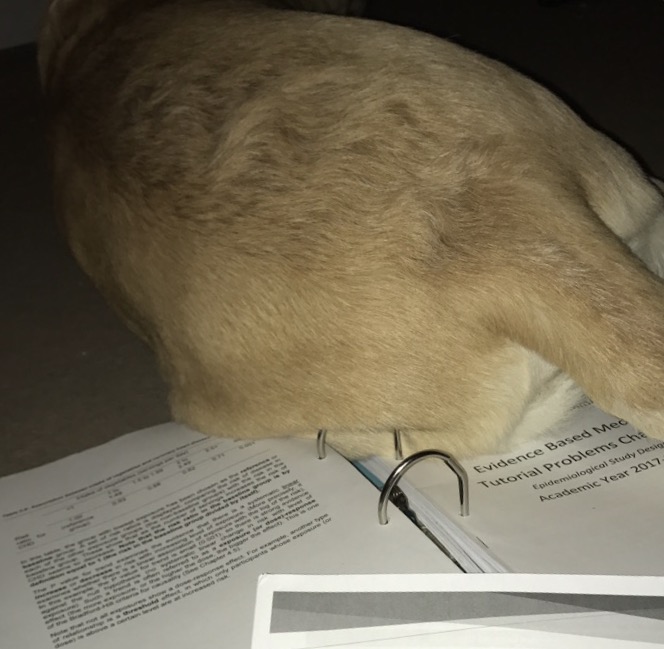 |
| This is my dog, who did make it challenging to revise at times when he would lay across my notes... |
The first exam was an anatomy exam. There were basically specimens positioned at different stations with a sheet of paper in front, asking us a question and to select the most appropriate from five answers (in a multiple choice way). You had a minute per station and roughly 80 to complete, so the exam was approximately an hour and a half long (counting the rest stations). In the anatomy practicals, it was very independent and self-led, which is why I was dreading the anatomy exam more than anything else. I felt that I was quite familiar with the 'majority' of body locations. So, if you asked me to draw out the gastrointestinal system, I probably could. I could point out the major organs, as well as the accessory organs. I could explain some of their functions, and even small extra detail like how the major duodenal papilla is where the pancreatic duct enters the duodenum. But I can not explain this using cadaveric specimens. Therefore, I decided over Christmas to completely redo my notes and update them with not just pretty coloured diagrams from an Anatomy Atlas, but to also incorporate images of cadaveric specimens that are readily available online.
 |
| I'm definitely more of a visual and creative learner, so I made this model of the cranial nerves and incorporated the cranial foramen names so I could revise both of these at the same time. |
But in the exam, you're testing on a few parts of anatomy PER question. Let me give you an example. You have a table at this station, with the pelvic girdle of a male situated in the centre. The pubic symphysis (the joint which joins the two hip bones at the front) has been represented by a solidified clear resin with a pin pierced through it. You look down at the sheet of paper accompanying this stand and see the question: "The structure being identified here is classified as what type of joint?" with a list of different types of joints: from primary cartilaginous joint, to secondary cartilaginous joint and named synovial joint types. But that is an example of how the one question actually asks quite a few: "What is this structure?", "What type of joint is it?", and you could even argue that it asks "Where is this joint?" and "What's the movement at this joint?" as it could help determine the type of joint this is classified as. Or you were given a radiography image, where you would have to quickly identify how the X-ray was taken (ie. from the side? from the front?), what is in the image, what structures are available, what does the white represent (ie. could be bone, could be fat) and then finally what is the answer to the question being asked? This is a lot to do in the short period of time at this station before you move to the next. However, it was just like in the MMIs that if you messed up one question and did not have a clue at this station, that dreaded buzzer declaring the end of the minute was a sign to suck up and move on, put it in the past and pray the next station provides better hope.
When the exam finished, my friends and I hit the nearby pub to discuss our answers over a coffee and large breakfast. The coffee helped us recover from the nervy-sleepless night before the exam, but to wake us up in preparation to go home and revise for the written exam tomorrow...
The written exam tested us on the behavioural, sociological, ethical and biochemical side of medicine. The paper consisted of multiple choice questions again, but this time asking questions that directly link to the lectures and tutorials we have had. I found this paper more difficult, mainly because I had stupidly spent my whole time allocated to revising anatomy. I was tested on genetic transcription, consent, what imaging should be requested for a patient presenting a certain condition, manipulating data from a graph I had to plot, what is epidemiology and so much more.
I will use this opportunity to describe how exams at university differ to how you may be used to it! GCSEs and A-Levels, you sit in rows of desks, are given the paper, started at the same time and then all finish at the same time. This is different to university! In university, you all start at the same time, but you can leave the exam hall when you've finished - just like what you've seen in the films! The only exception is that you cannot leave in the first half an hour of an exam or the last fifteen minutes, but as soon as you're finished (and hopefully proof read your answers), you can put your hand up, get permission from an invigilator and then you can leave!
I get my results in the first week of February, so who knows how I did. If I'm perfectly honest with you, I'm proud of how I did and know that I couldn't have tried any harder. I redone all of my notes in preparation for my anatomy exam and hope I see the result I really worked hard for. But you can never tell. We all have (especially me!) worked so so so hard for an exam, only to be devastated when opening that results sheet. I'll give you an update when the time comes, ay?
Subscribe to:
Posts (Atom)