Tuesday, 27 March 2018

Art Project...in progress

If you are interested in how the art assignment is working out at the moment, I have so far finished making the centre piece which is the anatomical representation of the abdomen. Being clay, it needs to dry out before it is fired and can be painted.

I'm thinking at the moment of painting the whole abdomen in its true colours (ie. slightly pinkish stomach, purple-like spleen, dark red liver etc) or painting them in paler pastel colours and the three kidneys in darker colours to bring attention onto them.

I plan to make small pills and capsules out of clay to represent the medication, and to stick this in some areas of the abdomen to show the reliance and dependence to keep the system working.

The holes in the hilum of the kidney and the major vessels in the centre (inferior vena cava and the abdominal aorta) will have coloured piping stuck into it which will connect them up. The clay was too fragile to roll thinly and connect as blood vessels (and the ureters), therefore I will do this after it has been fired.

The two kidneys have polycystic kidney disease, which meant I could use smaller pieces of clay rolled into balls to produce these cysts that are growing all over the kidney. I even scooped some clay out to represent burst cysts. The transplanted kidney is located at the bottom left.

As mentioned, the main purpose of my piece is to represent the dependence on medication (I was overwhelmed by the number of drugs transplant patients are administered after their operation!). So as the background of the board which my clay will be mounted to, I have designed these drugs based on the actual medication.

Example, I have found the name of certain immunosuppressants which are prescribed to renal transplant patients and have designed these on my computer (some based on their actual packets I could find online) and then printed these out and stuck them as a montage on the wooden board. I have also measured up and printed some of my own medication packets to stick to the boxes of over-the-counter medicines I had bought for this project. By doing so, I also have spare medicine packets that I can stick to my work too.

The montage of different medications that a renal transplant patient may be taking. I designed the packets online and stuck them to the board as a montage background for my clay piece.

Sunday, 25 March 2018

Assignments.... science vs. arts!

At the beginning of the year, I remember laughing with my flatmates how great it is that we don't get as many essays compared to other subjects. One of my flatmates who does biology is always complaining about another essay or report she has to do.

But, we were set an awful essay on discussing *something* and its impact on human health and wellbeing. The *something* had to be appropriate and from a certain list we were given (ie. diet, exercise, loneliness etc). I decided to do how owning a dog affects human health and wellbeing, which I thought initially would be very interesting. Was it? Of course not. For every paper that said owning a dog lowers your blood pressure, there was a study that proved that wasn't the case.

My essay based on the impact of owning a dog on human health and wellbeing. One of the hardest parts of writing this essay was actually trying to reference using the Vancouver method as opposed to Harvard, which is what I'm used to!

It was very complicated and repetitive, but I ploughed through. I lost out on a really good night, but I guess it was my fault for leaving it until the week it was due. Literature reviews and breaking down medical scientific journals is a talent that I really don't think I have compared to my friends.

My uni though is trying to promote this concept of medicine being both an art and a science. Therefore, we have also been set an art assignment. We have to base this on a clinical encounter that we have had or observed.

I have decided to create a reflective piece based on a patient that I met whilst doing a home visit in my GP placement. She has polycystic kidney disease, and her poor kidney function led to her having a kidney transplant. I was very shocked to learn that unless cancerous or posting a serious threat to life, they keep the kidneys inside you! I always thought they removed it during a transplant, but no!

The patient told me about how she believes it's the medication that is keeping her going. So I have based my art project solely on the amazing concept of a renal transplant, but also the dependence on medication to stay alive.

The plan for my art piece: an anatomical representation of the abdomen with the transplanted kidney (from the posterior abdominal muscles, to the bladder, major blood vessels, two PKD-affected kidneys, a transplanted kidney, to the liver, the stomach and the spleen). This will be moulded out of clay, dried over the holiday and fired in a kiln in the final week and ready for the deadline of the 20th April. Surrounding my clay piece will be the tablets a renal patient will be taking to prevent rejection or any infection post-operation. I have researched these drugs online, and through the use of NHS renal transplant information leaflets which are given to patients before or after their transplant operation.

The beginning base for my anatomical representation of the abdomen, crafted out of clay. On the paper is my rough plan of how I plan to lay out the structures.
I will keep you updated on how this turns out!

Friday, 23 March 2018

Term 2 Done, One to Go!

...and shot to that!
That's another term completed, with just one more to go! This year is going so fast, I thought the teachers in my sixth form were exaggerating when they said it'll go this quickly.

This term has been full of the more sciencey anatomy body stuff which has made it 10 times more interesting and gripping! The labs have got more interesting definitely with an extension on the histology content, looking at how the epithelium of the bladder allows it to expand and return to its original shape etc.

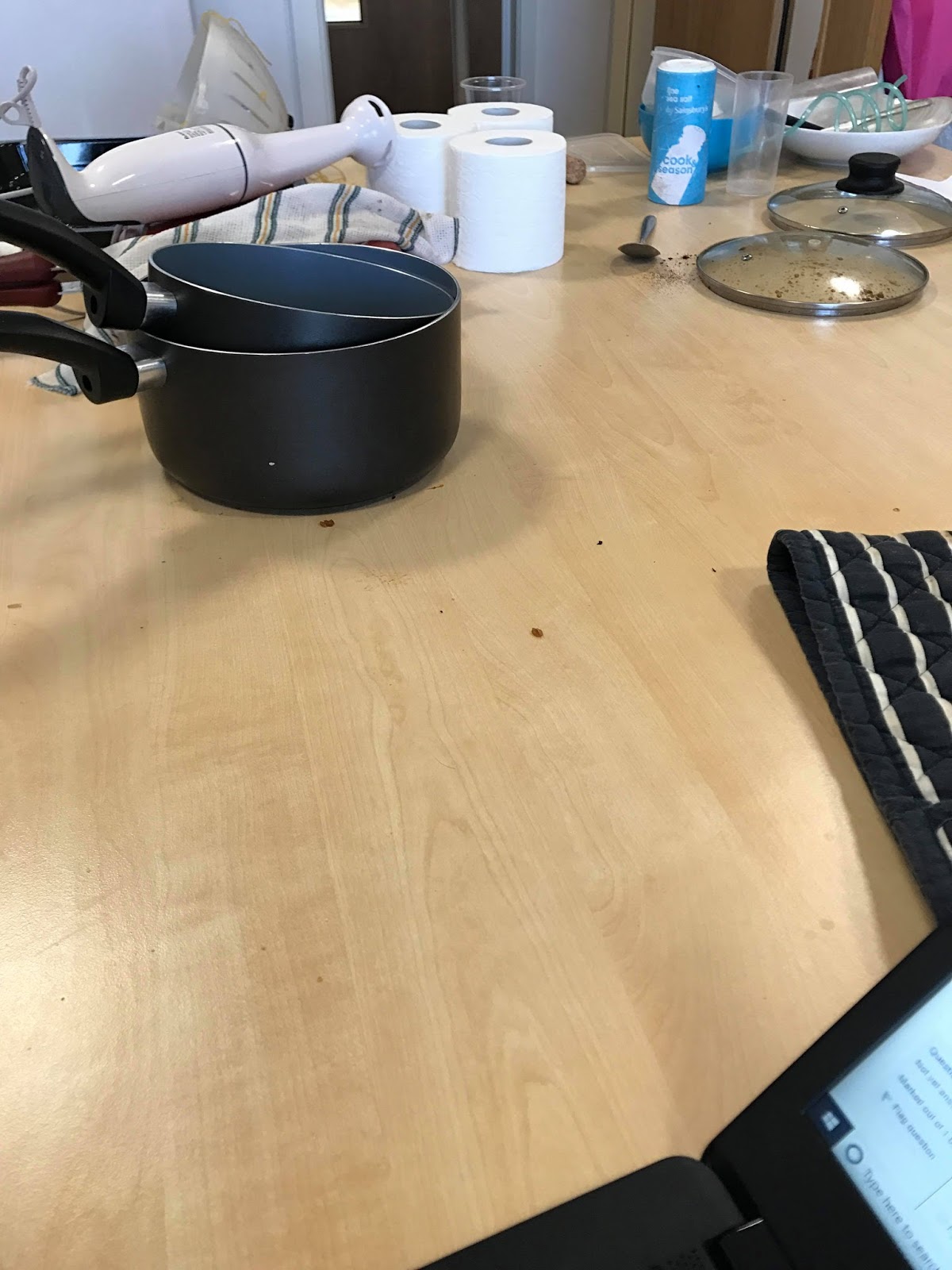
This is what the typical student kitchen looks like - piles of washing up that "will be done tomorrow, I promise"
I have somehow survived on the amount I've drank and the fact I've probably eaten twice my body weight in pasta and jarred tomato and basil sauce. But one day I did cook for myself and my flatmate by surprising her with my steak-cooking skills!

The steak meal in discussion - including the homemade peppercorn sauce that sounds revolting on paper but tastes and smells perfect in person.

I made my own peppercorn sauce out of Vodka, gin, pink lemonade, ground pepper, baking powder, gravy, milk and butter - and it tasted like it had been made in a top restaurant (if I say so myself). If anything, it was very peppery and if it wasn't eaten fast enough, it would solidify and slide off your steak! If you want the recipe, just private message me!

I gave a talk to aspiring medical students for Villiers Park based on my experiences.

I've had the honour as well to be invited back to my school to give a talk regarding future aspirations post-18. Before this though, I was invited back to give a presentation to aspiring medical students at Villiers Park (in MedSoc that I was once part of) and explaining what it's like to be a first year medical student, how to get in and if medicine does seem what I expected! The students that attended (30+ I think!) asked some great questions throughout the slides and I can't believe that this time last year I was sat in their seats listening to a guy give a talk in MedSoc.

I recommended they read this blog, so they could be viewing this article with you!

Until next term, have a great Easter!

Wednesday, 21 March 2018

Getting the job as a HCA!

Prior to finishing this term, I had to complete some more hospital shifts as a healthcare assistant. During my week, I had the opportunity to work on the ward for complex needs. This allowed me to develop experience working with patients with high dependence and little or no independence at all. The majority of my shift involved taking observations and speaking with the patients and nurses, or helping patients feed or go to the toilet.

On break...with a disgusting cold cup of coffee...
I have recently really enjoyed working as a healthcare assistant so decided to apply for the job at the hospital as a Band 2 Healthcare Assistant - which I am happy to say I got the job! It could possibly mean I could stop commuting to my hometown to work in my retail store (where I have been working now for three years) and live permanently in my new city and work at the hospital there.

In this article, I'll describe some of the questions I was asked in my group interview regarding working at the hospital as a healthcare assistant...

  • Why do you want to become a Healthcare Assistant? What are you currently doing?
  • Have you had an experience which demonstrates your excellence in quality of care you deliver?
  • Have you had an experience which demonstrates your respect for the patient and their dignity?
  • What characteristics should a Healthcare Assistant have? What characteristics have you listed, do you demonstrate? (And provide some examples)
I also had to take part in a 30 minute numeracy paper and a 30 minute literacy paper in the assessment centre.

I got the results two days later, saying my job offer is conditional on a reference from my current line manager which was successful!

All of the nurses I have worked with have said that the perfect doctors have been healthcare assistants once in their life. Apparently, it creates great doctors who sympathise with the rest of the team and respect all the staff on the ward as you understand everyone's role, stresses and job role. This reduces the chance of a "pretentious doctor walking down the ward like they're better than everyone else."

Thursday, 8 March 2018

Strike and Snow!

You can't escape it. I'm sure you've read it for yourself in the news, but the majority of university lecturers are currently on strike due to changes in their pension.

Some of my friends have been massively affected by these strikes! One of my friends who studies politics at my university has lost out on around four weeks of teaching. They have stated there will be some amendments to the end-of-year examinations to cater for this loss, but he has still had to pay for nothing for the past month!

Caption says it all really - bored students with their lecturers on strike have nothing better to do than try to score their teabag in a cup.

For us medical students, we weren't affected! We had one lecture on diet and nutrition which was cancelled, but the majority of our lectures and tutorials are delivered by actual NHS doctors. Therefore, they have the NHS pension so are not affected by the striking conducted by university lecturers across the UK.

But we were affected by the Beast from East! The university deemed it unsafe for students and staff to attend university so it closed its facilities. I lost out on a tutorial and a lecture, but I had managed to get to my placement in the hospital that morning!

I loved the university's response to the snow... they shut the university for the safety of the students. But the students retaliate by sledging down the steep hills in the uni accommodation on just trays from the catering cafe or recycling bin lids. I feel to be honest that closing the university put our safety at risk!


There was a massive bread crisis in all of our local grocery shops - how on earth will we have toast in the morning?!

Snow settled all over the university accommodation and the city. It made waiting for buses (if they ever arrived) harder when the benches are covered in snow. The Beast from the East forced you to buy that cappuccino from the cafe, otherwise you'd freeze to death!

Monday, 5 March 2018

Birthday Blues - away from home!

All of the cards I got to open on my 19th birthday at uni.
I don't know whether you guys are in the same boat as me, but I am a March baby. Therefore, just like other years, my birthday has always fallen in the centre of a school term so I'm used to having to spend the day at school before I come home and celebrate my birthday. But for the firs time, I was actually away for my birthday at university!

I was dreading it, but my flatmates made my birthday great! I enjoyed every second of it! They threw a surprise party for me when I got home from university with presents and a collection of photos of us all and they also posted embarrassing photos and videos of me on social media for my birthday!

I video messaged my family from my halls, which wasn't the same but as good as it gets. I took all of my cards to uni so I could at least open something from home, but I really did enjoy spending my 19th birthday with great people.

I love fish (and am a fishkeeper myself) so my flatmates made me a sea themed cake! And it tasted amazing!
We then went out, dressed as the Spice Girls for the themed night at the student nightclub. My birthday was a Monday, so it's student tradition (like a religion!) to go out and we celebrated my birthday! My flatmate, who has never gone to a club before and doesn't usually drink alcohol, came out especially for my birthday which made it even better!

Wednesday, 21 February 2018

Case-Based Learning

CBL = case-based learning; this is the type of teaching which my university is using to deliver its information to us medical students.

I find this such a great way of learning and it's very useful because it keeps all the information together. Each cycle is the same, just with a different system. So far for this year, we have studied the musculoskeletal system, cardiovascular system, respiratory system, gastrointestinal system and the urinary system. After the holiday, in term 3, we will be studying the neuro system and finally the endocrine system.

The cases are taught in two week cycles. These two weeks contain three facilitation sessions, one day of labs (and one session in the anatomy dissection room), one day of placement (GP or hospital, these are rotated) and ten lectures that deliver information on this section.

At the beginning of the cycle, we are given a case (of around 500 words) which will introduce us to a condition or complaint being presented by a patient regarding the cycle. So for cardiovascular, we had a patient with high blood pressure. In the musculoskeletal case, we looked at the use of anabolic steroids to develop muscle mass. In the urology case, we looked at two people who drank a certain amount of water before a marathon and the effects of dehydration etc. The problems described in the case will then be explored in our lectures for this case.

As an example, I will be using the respiratory case:
  • Three facilitation sessions where we discuss the current case that has been presented to us. We sit and go through the learning objectives in the first facilitation session at the beginning of the cycle. We can identify parts of the case we don't understand that may not be or fully covered in lectures, so we will distribute and delegate presentations to each other and present them in the following facilitation session. We have another facilitation session mid-cycle to work out where we all are, and then a final session to conclude the case and clarify any final information we are struggling with or want help with (from the guidance of our facilitator who supervises us).
  • 10 lectures - all delivered on the respiratory system but divided up across the two weeks. In these lectures, we learnt about the anatomy of the lung, how the lungs ventilate to provide gaseous exchange, what is gaseous exchange and the respiratory and metabolic responses within the body (at a cellular and organ level).
  • One lab session in anatomy where we used cadavers to study the respiratory anatomy. In this session, we located the lungs, the pleura and other structures in the chest and mediastinum. But we also learnt about reading and interpreting x-rays of the chest and an introduction to taking a chest examination.
  • I had placement in the GP, which meant I had the opportunity to do a home visit and meet a patient who had severe asthma. On the home visit, I was able to use my history taking skills to listen to the patient and understand the difficulties she experiences, but also apply the knowledge I had learnt in this cycle about the pathology and physiology causing her symptoms.
  • People that had placement at the hospital for this cycle had the opportunity to practise percussion (banging your fingers on the chest to produce a sound which can signify hollowness [from air] or dullness [from a build-up of fluid]). There was also the chance to auscultate the chest (use a stethoscope to listen to the different lobes of the lung) and where to place the stethoscope.
  • One lab session using the simulation patient to look at the effects of hyperventilation and climbing in altitude on the patient's respiratory rate, consciousness and oxygen saturation levels.
  • One lab session on the effects of exercise on respiration (so doing an exercise activity and measuring the increase in respiratory rate etc).
This is the same structure for all of the cases.